The Mathematical Basis Of Convex Optimization
2018-02-22
This winter vacation i’m trying to understand this course–Convex Optimization,with current paper.I want make some contribution to some open problems in the field of communicaton optimization.
This will be a series of articles,where i only give the most basic mathematical concepts,the other will be separate article.
Reference material:
- Convex Optimization -by Stephen Boyd
- PKU Course-00136660 Lecture
Lines and line segements
Suppose \(x_1\neq x_2\) are two points in \(R^n\),Point of form \(y=\theta x_1+(1-\theta)x_2,\theta \in R\) form the line passing through \(x_1\) and \(x_2\).
Values of the parameter \(\theta\) between 0 and 1 correspond to the (closed) line segement between \(x_1\) and \(x_2\).
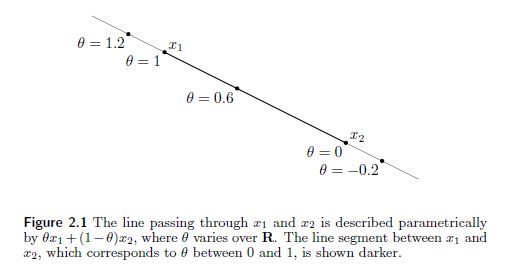
Affine sets
A set \(C \subseteq R^n\) is affine if the line through any two distinct points in \(C\) lies in \(C\).
If for any \(x_1\),\(x_2 \in C\) and \(\theta \in R\),we have \(\theta x_1 + (1 - \theta)x_2 \in C\).In other word,\(C\) contains the linear combination of any two points in \(C\),which sum to one.
The idea can be generalized to more than points.We refer to a point of the form \(\theta_1 x_1+\ldots +\theta_kx_k\),where \(\theta_1 x_1+\ldots +\theta_kx_k = 1\),as an affine combination of the points \(x_1,\ldots,x_k\).
Using induction from the definition of affine set \(i.e\) that it contain every affine combination of two points in it,it can be shown that an affine set contain every affine combination of its points.If C is an affine set,\(x_1,\ldots,x_k \in C\),and \(\theta_1 x_1+\ldots +\theta_kx_k = 1\),then the point \(\theta_1 x_1+\ldots +\theta_kx_k\) also belong to \(C\).
..etc(i will write it in nextday)